“This Time, It’s Personal”: America’s Retrial on Iran
- Riddhima Shivani
- Aug 1
- 7 min read
Ayatollah Ali Khamenei, Iran’s Supreme Leader, was killed in a joint US-Israeli strike on a compound in Tehran on the morning of February 28, 2026. The strike also killed his daughter, son-in-law, a grandchild, commander of the IRGC, the defence minister, and the armed forces chief of staff. The Pentagon named it Operation Epic Fury. Eight days later, the succession question was closed: Khamenei’s son Mojtaba was named the new Supreme Leader. A regime, it turns out, can survive losing its head faster than the people who took the head expected.

This was not America’s first attempt at deciding Iran’s leadership by force. About seventy-three years earlier, a CIA-MI6 operation codenamed TPAJAX removed Prime Minister Mohammad Mossadegh after he nationalised the Anglo-Iranian Oil Company. Most can draw the coincidences: American policy toward Iran has, for decades, run on the assumption that a more convenient Iran is always sitting somewhere, waiting to be installed.
Here, we will try to identify this parallel, and treat the two operations as two distinct kinds of intervention that arrived at the same result, i.e., a foreign government deciding it could identify Iran’s legitimate leadership more reliably than Iranians could. What follows works through the 1953 record in detail, returns to the legal questions raised by the 2026 strike, and then asks what the two operations do and don’t have in common.
The most familiar version of the 1953 coup casts the CIA as its main instigator, Kermit Roosevelt as master puppeteer, Mossadegh as the democrat, curtain down. That version has been complicated by the Wilber Report (“The Battle for Iran”), CIA historian Scott Koch’s 1998 internal history, a 1,007-page State Department FRUS volume released in 2017, and British files surfaced by historian Mark Gasiorowski and the NSA. Together, they posit that the coup was not originally America’s idea. Declassified memos show it was pitched to the Truman administration by the British government in October and November 1952, nearly a year before Eisenhower’s CIA approved one of its own.
The Anglo-Iranian Oil Company, the British-run predecessor to BP, had for decades taken home profits nearly triple what it paid Iran in royalties. Britain was furious. America, initially, was not. Eisenhower himself called Mossadegh “the only hope for the West in Iran” as late as March 1953. That changed the moment Britain stopped talking about oil and started talking about Russia, reframing the dispute as a Cold War problem, and warning that Iran was drifting toward a communist regime. The CIA, then six years old and hungry to prove it belonged in the room, got the green light.
Kermit Roosevelt Jr., grandson of Theodore Roosevelt, flew to Iran with roughly a million dollars, and bought out journalists, clerics, and street toughs to manufacture the appearance of a popular uprising against Mossadegh. The Wilber Report describes the resulting mobs as the product of a propaganda campaign. The CIA had paid Iranian journalists to publish fake news, anti-Mossadegh editorials, and cartoons, and printed entire counterfeit newspapers designed to look like they belonged to local communist or opposition groups. Agents faked threats and staged sham bombings against the homes of prominent religious leaders to frighten Iran’s clergymen into turning on Mossadegh before they had time to ask who was actually behind the blasts.
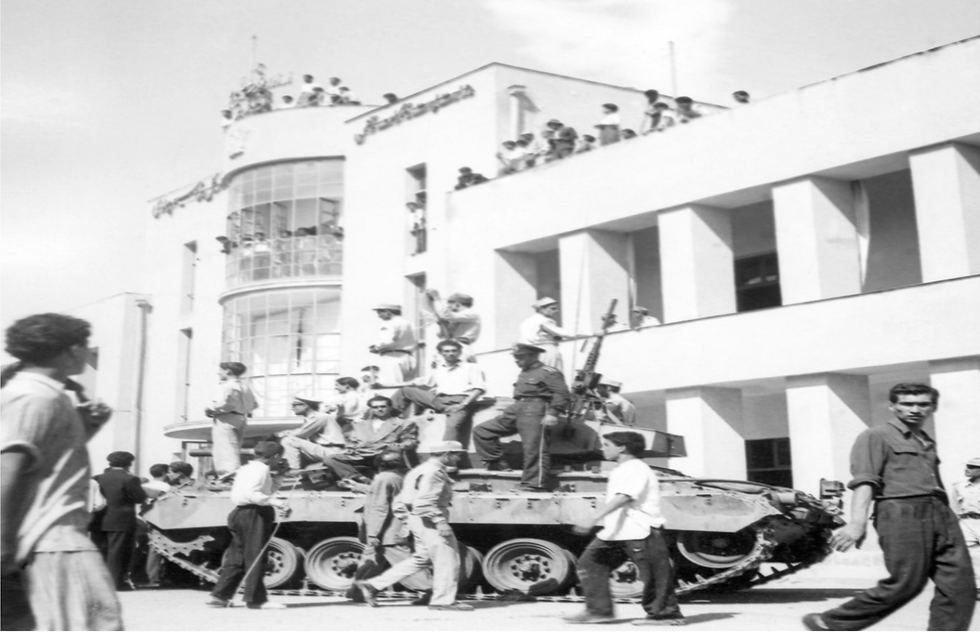
It worked fast. Mohammad Reza Pahlavi, Shah of Iran, backed by the CIA and MI6, dismissed Mossadegh as Prime Minister. On August 19, 1953, military forces loyal to General Fazlollah Zahedi overthrew Mossadegh’s government, took effective control of Tehran, and restored the Shah to power. Pahlavi then went on to build an authoritarian regime, protected by the brutal secret police force SAVAK and backed by America, which heavily restricted political freedom for Iranians. In 1963, he launched the White Revolution, a modernisation program that included land reform and women’s rights. But his reliance on secret police and Western allies fed a growing anger that, in 1979, triggered the Islamic/Iranian Revolution.
As Prime Minister, Zahedi and his government cracked down on political opponents, particularly the communist Tudeh Party, and negotiated a resolution to the oil dispute that had stalled Iran’s economy since Mossadegh’s nationalisation. But as Zahedi’s popularity grew, the Shah came to see him as a rival rather than an ally, and forced him out of the premiership in 1955. Zahedi was subsequently appointed Iran’s ambassador to the United Nations in Geneva, where he remained until his death in 1963. The coup that overthrew Mossadegh is remembered as an operation against a secular nationalist. It was also a joint Anglo-American effort to arm and fund the same current of Iranian political Islam that would depose the Shah twenty-six years later.
The 2026 file is thinner on declassified archives, for the obvious reason that seventy years haven’t passed yet, but it is far better documented in real time. Multiple outlets confirmed the strike and Khamenei’s death within hours. Trump reportedly turned down an earlier Israeli proposal to kill Khamenei outright, posting on Truth Social in June that the Supreme Leader was “an easy target, but is safe there. We are not going to take him out (kill!), at least not for now”.
Some questions that are worth pulling apart, because they get flattened together too easily.
Did precedent already rule this out?
In 2020, UN Special Rapporteur Agnes Callamard reviewed the drone killing of Qassem Soleimani and found that the United States had failed to demonstrate the imminent threat required to justify the strike as self-defence under Article 51 of the UN Charter. Evidence of past attacks, she concluded, could not establish an ongoing one. Soleimani, unlike Khamenei, had a documented operational role in attacks on US personnel.

Does the US assassination ban even apply here?
The ban does not require that an American pull the trigger. Executive Order 12333, signed by Reagan in 1981 and tracing back to Ford’s 1976 order, states that no one acting on behalf of the US government “shall engage in, or conspire to engage in, assassination”. Section 2.12 extends the prohibition further that no element of the intelligence community may “participate in or request any person to undertake” what the order forbids, a clause a 1989 Pentagon legal memorandum took seriously enough to spend several pages defining. If the reported US intelligence-sharing on Khamenei’s location is accurate, the open question is whether American targeting assistance violated that standing order on its own terms, independent of who actually fired the missile. No administration has offered a public theory for why it didn’t.
Was Khamenei a lawful target at all?
Being a head of state does not automatically make you one, even mid-war. The framework most often cited for targeted killings of enemy leadership, laid out by State Department Legal Adviser Harold Koh in a 2010 address to the American Society of International Law, requires an existing armed conflict, a target who qualifies as a combatant rather than a civilian, and means that are proportionate and discriminating. Qaddafi and Soleimani are generally treated as clearing that bar because of their documented operational military roles. Khamenei’s role was supreme under Iran’s constitution, but in principle it was political and religious rather than operational. Additional Protocol I to the Geneva Conventions protects civilians “unless and for such time as they take a direct part in hostilities”, which he doesn’t meet on public records. None of this settles the strike’s legality either way.
The differences are not cosmetic, though. TPAJAX was built to be deniable and stayed that way for sixty years; Epic Fury was announced by name, along with the people who ordered it, within hours. TPAJAX also predates any binding international law specific to targeted killings of foreign leaders. Epic Fury tests, at minimum, the UN Charter’s Article 2(4), the post-Church Committee assassination ban, and the Additional Protocol I combatant test. That architecture was built after Watergate and the Church Committee to prevent a repeat of TPAJAX-style regime change. It was never built to anticipate a publicly acknowledged strike on a sitting head of state in the middle of a war, and it is currently being interpreted by the same governments that carried the operation out. That is an uncomfortable position from which to referee, and there is no settled precedent to resolve it.
There is a fourth difference: who gets to control the story, and for how long? The 1953 coup lived under classification for six decades. The CIA’s own internal historians wrote three separate accounts of it, and the public did not get a meaningfully complete one until the National Security Archive’s Mandatory Declassification Review requests pried loose the 2017 release. For most of that time, the operative American position was simple denial. Kermit Roosevelt wrote a memoir about it in 1979 and the CIA, by its own account, made him cut the parts that were “essentially a work of fiction”, because they were close enough to the truth to matter. An entire generation of Iranians grew up being told by their own government, and disbelieved by large parts of it, that a foreign hand had put the Shah back on the throne, with no document either side could point to.
Operation Epic Fury had no such runway. Satellite imagery of the strike compound was public within a day. Iranian state media confirmed the deaths of Khamenei’s daughter, son-in-law, and grandchild within seventy-two hours of denying his death outright. The Pentagon’s own secretary and Joint Chief’s chairman stood in front of cameras and named the operation themselves. Iranian and American accounts of the same seventy-two hours already disagree on when Khamenei actually died, who authorised the intelligence sharing, and how close the Omani talks really were. Speed changed who could deny the strike happened, but not who gets to decide what the strike meant, and on that question, TPAJAX and Epic Fury may end up looking more alike than the six-decade gap between their paper trails suggests.
Whether Mojtaba Khamenei turns out to be a placeholder or a genuine successor is a separate question from whether removing his father was lawful. And whether it was lawful is a separate question again from whether it was wise, or whether it worked. The 1953 file suggests those three things have a habit of arriving on very different timelines. Seventy years ago, the CIA needed rented mobs, an exiled Shah hiding in a Rome hotel, and a station chief who ignored a direct order to stand down. In 2026, the United States and Israel needed two Cyber Command teams, an airstrike, and a Truth Social post. Whether that counts as progress depends entirely on which of the three questions you think has already been answered, and Iran’s own history suggests the answer to all three can still change.



Comments